Exaption: Alternatives to the Modular Brain, Part II

Scientists discovered the part of the brain responsible for…

In my last post, I discuss one alternative to the modular theory of the mind/brain relationship: connectionism. Such a model is antithetical to modularity in that there are only distributed networks of neurons in the brain, not special-purpose processors.

One strength of the modular approach, however, is that it maps quite well to our folk psychology. And, much of the popular discourse surrounding research in neuroscience involves the celebrated “discovery” of the part of the brain responsible for X. A major theme of the previous posts is that the social sciences should be skeptical of the baggage of our folk psychology. But, is there not some truth to the idea that certain regions of the brain are regularly implicated in certain cognitive processes?

The earliest attempts at localization relied on an association between some diagnosed syndrome—such aphasia discussed in the previous posts—and abnormalities of the brain’s structure (i.e. lesions) identified in post-mortem examinations. For example, Paul Broca, discussed in my previous post, noticed lesions on a particular part of the brain in patients with difficulty producing speech. This part of the brain became known as Broca’s area, but researchers only have a loose consensus as to the boundaries of the area (Lindenberg, Fangerau, and Seitz 2007).

Furthermore, the relationship between lesions in this area and aphasia is partial at best. A century later, Nina Dronkers, the Director of the Center for Aphasia and Related Disorders, states (2000:60):

After several years of collecting data on chronic aphasic patients, we find that only 85% of patients with chronic Broca’s aphasia have lesions in Broca’s area, and only 50–60% of patients with lesions in Broca’s area have a persisting Broca’s aphasia.

More difficult for the modularity thesis, those with damage to Broca’s area and who also have Broca’s aphasia usually have other syndromes. This implies that the area is multi-purpose, and thus not a single-purpose language production module (see this book-length discussion Grodzinsky and Amunts 2006). One reason I focus on Broca’s area (apart from my interest in linguistics) is that it is considered the exemplary case for the modular theory quite dominant (if implicit) in much neuroscientific research (Viola and Zanin 2017).

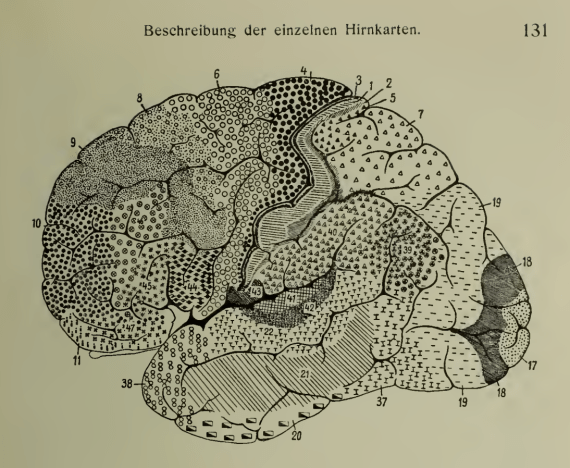
Part of the difficulty with assessing even weak modularity hypotheses, however, is that neuroanatomical research continues to revise the “parcellation” of the brain. The first such attempt was by Korbinian Brodmann, published in German in 1909  as “Comparative Localization Studies in the Brain Cortex, its Fundamentals Represented on the Basis of its Cellular Architecture.” He divided the cerebral cortex (the outermost “layer” of the brain) into 52 regions based on the structure of cells (cytoarchitecture) sampled from different sections of brains taken from 64 different mammalian species, including humans (see Figure 1). Although Brodmann’s studies were purely anatomical, he wrote: “my ultimate goal was the advancement of a theory of function and its pathological deviations.” Nevertheless, he rejected what he saw as naive attempts at functional localization:

[Dressing] up the individual layers with terms borrowed from physiology or psychology…and all similar expressions that one encounters repeatedly today, especially in the psychiatric and neurological literature, are utterly devoid of any factual basis; they are purely arbitrary fictions and only destined to cause confusion in uncertain minds.
20180522-Selection_003
Figure 1. Brodmann’s handdrawn parcellation of the human brain.

Over a century later, many researchers continue to refer to “Brodmann’s area” numbers as general orientation markers. More recently (see Figure 2), using data from the Human Connectome Project and supervised machine learning techniques, a team of researchers characterized 180 areas in each hemisphere — 97 new areas and 83 areas identified in previous work (Glasser et al. 2016). This study used a “multi-modal” technique which included cytoarchitecture, like Brodmann, but also connectivity, topography and function. For the latter, the study used data from “task functional MRI (tfMRI) contrasts,” wherein resting state measures are compared with measures taken during seven different tasks.

glasser-map

One of these tasks was language processing using a procedure developed by Binder et al. (2011) wherein participants read a short fable and then are asked a forced-choice question. Glasser et al. found reasonable evidence associating this language task with previously identified components of the “language network” (for recent overviews of the quest to localize the language network, see Frederici 2017 and Fitch 2018, both largely within the generative tradition).  Specifically, these are Broca’s area (roughly 44) and Wernicke’s area (roughly PSL), and also identified an additional area, which they call 55b). Their findings also agreed with previous work going back to Broca on the “left-lateralization” of the language network—which means not that language is only in the left hemisphere (as some folk theories purport), but simply the left areas show more activity in response to the language task than in homologous areas in the right hemisphere (an early finding which inspired Jaynes’ Bicameral Mind hypothesis)

Does this mean we have discovered the “language module” theorized by Fodor, Chomsky, and others? Not quite, for three reasons. First, Glasser et al. found if they removed the functional task data, their classifier was nearly as accurate at identifying parcels. Second, the parcels were averaged over a couple hundred brains, and yet the classifier was still able to identify parcels in atypical brains (whether this translated into changes in functionality was outside the scope of the study).

Third, and most important for our purposes, this work does not—and the researchers do not attempt to—determine whether parcels are uniquely specialized (or encapsulated in Fodor’s terms). That is, while we can roughly identify a language network implicating relatively consistent areas across different brains, this does not demonstrate that such structures are necessary and sufficient for human language, and solely used for this purpose. Indeed, language may be a “repurposing” brain parcels used for (evolutionarily or developmentally older) processes. This is precisely the thesis of neural “exaption.”

What is Exaption?

In the last few decades several new frameworks—under labels like neural reuse, neuronal recycling, neural exploitation, or massive redeployment—attempt to offer a bridge between the modularity assumptions which undergird most neuroanatomical research, on one hand, and the connectionist assumptions which spurred advancements in artificial intelligence research and anthropology on the other. Such frameworks also attempt to account for the fact there is some consistency in activation across individuals, which does look a little bit like modularity.

The basic idea is exaption (also called exaptation): some biological tendencies or anatomical constraints may predispose certain areas of the brain to be implicated in certain cognitive functions, but these same areas may be recycled, repurposed, or reused for other functions. Exemplars of this approach are Stanislas Dehaene’s Reading in the Brain and Michael Anderson’s After Phrenology.

Perhaps the easiest way to give a sense of what this entails is to consider cases of neurodiversity, specifically the anthropologist Greg Downey’s essay on the use of echolocation by the visually impaired. While folk understandings may suggest that hearing becomes “better” in those with limited sight, this is not quite the case. Rather, one study finds, when listening to “ a recording [which] had echoes, parts of the brain associated with visual perception in sighted individuals became extremely active.” In other words, the brain repurposed the visual cortex as a result of the individual’s practices. While most humans have limited echolocation abilities and the potential to develop this skill, only some will put in the requisite practice.

Another strand of research supporting neural exaption falls under the heading of “conceptual metaphor theory” (itself a subfield of cognitive linguistics). The basic argument from this literature is that people tend to reason about (target) domains they have had little direct experience with by analogy to (source) domains with which they have had much direct experience (e.g. the nation is a family). As argued in Lakoff and Johnson’s famous Metaphors We Live By, this metaphorical mapping is not just figurative or linguistic, but rather a pre-linguistic conceptual mappings, and an—if not the—essential part of all cognition (Hofstadter and Sander 2013). Therefore, thinking or talking about even very abstract concepts re-activates a coalition of neural associations, many of which are fundamentally adapted to the mundane sensorimotor task of navigating our bodies through space. As we discuss in our forthcoming paper, “Schemas and Frames” (Wood et al. 2018), because talking and thinking recruit areas of our neural system often deployed in other activities—and at time-scales faster than conscious awareness can adequately attend—our biography of embodiment channels our reasoning in ways that seem intuitive and yet are constrained by the pragmatic patterns of those source domains. This is fully compatible with the dispositional theory of the mental Omar discusses.

What does this mean for sociology? I think there are numerous implications and we are just beginning to see how generative these insights are for our field. Here, I will limit myself to discussing just two, specifically related to how we tend to think about the role of language in our work. First, for an actor, knowing what text or talk means involves an actual embodied simulation of the practices it implies, very often (but not necessarily) in service of those practices in the moment (Binder and Desai 2011). Therefore, language should not be understood as an autonomous realm wherein meanings are produced by the internal interplay of contrastive differences within an always deferred linguistic system. Rather, following the later Wittgenstein in the Philosophical Investigations, “in most cases, the meaning of a word is its use.” Furthermore, as our embodiment is largely (but certainly not completely) shared across very different peoples (for example, most of us experience gravity all the time), there is a significant amount of shared semantics across diverse peoples (Wierzbicka 1996)—indeed without this, translation would likely be impossible.

Second, the repurposing of vocabulary commonly used in one context into a new context will often involve the analogical transfer of traces of the old context. This is because invoking such language activates a simulation of practices from the old context while one is in the new context. (Although this is dependent upon the accrued biographies of the individuals involved). This suggests that our language can be constraining in predictable ways, but not because the language itself has a structure or code rendering certain possibilities unthinkable. Rather, it is that language is the manifestation of a habit inextricably involved in a cascade of other habits, making it easier to execute  (and therefore more probable for) some actions or thoughts over others. For example, as Barry Schwartz argued in his (criminally under-appreciated) Vertical Classification, it is nearly universal that UP is associated with power and also the morally good as a result of (near-universal) practices we encounter as babies and children. This helps explain the persistence of the “height premium” in the labor market (e.g., Lundborg, Nystedt, and Rooth 2014).


References

Binder, Jeffrey R. et al. 2011. “Mapping Anterior Temporal Lobe Language Areas with fMRI: A Multicenter Normative Study.” NeuroImage 54(2):1465–75.

Binder, Jeffrey R. and Rutvik H. Desai. 2011. “The Neurobiology of Semantic Memory.” Trends in Cognitive Sciences 15(11):527–36.

Dronkers, N. F. 2000. “The Pursuit of Brain–language Relationships.” Brain and Language. Retrieved (http://www.ebire.org/aphasia/dronkers/the_pursuit.pdf).

Fitch, W. Tecumseh. 2018. “The Biology and Evolution of Speech: A Comparative Analysis.” Annual Review of Linguistics 4(1):255–79.

Friederici, Angela D. 2017. Language in Our Brain: The Origins of a Uniquely Human Capacity. MIT Press.

Glasser, Matthew F. et al. 2016. “A Multi-Modal Parcellation of Human Cerebral Cortex.” Nature 536(7615):171–78.

Grodzinsky, Yosef and Katrin Amunts. 2006. Broca’s Region. Oxford University Press, USA.

Hofstadter, Douglas and Emmanuel Sander. 2013. Surfaces and Essences: Analogy as the Fuel and Fire of Thinking. Basic Books.

Lindenberg, Robert, Heiner Fangerau, and Rüdiger J. Seitz. 2007. “‘Broca’s Area’ as a Collective Term?” Brain and Language 102(1):22–29.

Lundborg, Petter, Paul Nystedt, and Dan-Olof Rooth. 2014. “Height and Earnings: The Role of Cognitive and Noncognitive Skills.” The Journal of Human Resources 49(1):141–66.

Viola, Marco and Elia Zanin. 2017. “The Standard Ontological Framework of Cognitive Neuroscience: Some Lessons from Broca’s Area.” Philosophical Psychology 30(7):945–69.

Wierzbicka, Anna. 1996. Semantics: Primes and Universals. Oxford University Press, UK.

Wood, Michael Lee, Dustin S. Stoltz, Justin Van Ness, and Marshall A. Taylor. 2018. “Schemas and Frames.” Retrieved (https://osf.io/preprints/socarxiv/b3u48/).


To Feel or Not to Feel? That is No Longer the Question

It is highly likely that most readers recall learning about Phineas Gage, a railroad worker who, in 1848, had the misfortune of having a 3.5 inch, 13+ lb. metal rod (with a diameter of 1 ¼ inches) impale him. The rod went through his open mouth, behind his left eye, and out of his skull. What was exceptional in all of this, was that it neither exited his skull completely nor did he die from this injury for 12 years! Considering the state of medical knowledge and technique, this was a rather incredible and improbable survival, and I would bet that is what most people remember about his story.

Yet, for a theorist and sociologist, there is much, much more to this anecdote than the sensational. His memory, for instance, was discernibly unaffected, but the injury, by accounts of both former employers and professional “trained” in the “psychology” of yore, had somehow peeled back the protective human layers of socialization. That is, he was described as vacillating between his “intellectual faculties” and “animal propensities”; his behavior and language could be “coarse,” “vulgar,” and offensive to any “decent” people he might encounter. In spite of this, he spent seven of the 12 years left of his life in Chile, working as a long-distance stagecoach driver; which, in 1852, would have demanded a lot of cognitive skills given the temporal and physical and social demands. He was clearly successful.

What can we learn from this case? On the surface, probably not much. A debate between contemporary neuroscientists centers on how much we can draw from MRIs of a skull with no direct empirical evidence. Gage’s former employers may have maligned his reputation to protect their financial interests; doctors of the day were rarely scientific in their orientation or beholden to a professional association backed by the force of legislation; and, psychology was barely in its infancy. Nonetheless, it is not incorrect to say that damaging the brain, in most cases, leads to changes in behavior and personality.

But, what does Gage have to do with sociology and cognition? His case and others that would follow in the early 20th century inspired a body of research examining brain lesions, particularly the prefontal lobe, which is responsible for rational decision-making. For instance, in one of many experiments, Bechara, Damasio, Damasio, and Anderson (1994) provided “normals” and patients with a $2000 loan, and provided them with four decks of cards and some basic instructions: don’t lose money, but make $$ if possible. Turning a card in pile A or B rewarded $100 while C and D only $50. The catch: some cards in A and B, unbeknownst to the player, demanded a sudden high payment (e.g., $1250), while C and D, on occasion, only asked for small, modest payments (e.g., $100). Normals began by sampling all the decks, showing preferences for A and B at first, but gradually learning that C and D are the best bets. Those with damaged brains, however, started the same way but did not switch to C and D, no matter how many times they bankrupted.

From a series of follow up experiments meant to tease out specific hypotheses about rewards and punishments, and his own clinical work with lesion patients, Antonio Damasio (1995) cogently posited—at the time—a revolutionary thesis: reasoning and rationality are inextricably entwined with emotions. The classic Cartesian model of brain v. soul that undergirds seemingly false (but commonly, often unconsciously, accepted) dichotomies like rationality v. irrationality, cognition v. emotion collapses under the weight of empirical evidence.

This seems eminently sensible. Marketers draw on psychology to appeal not only to our cool rationality, but to our feelings and sentiments. We choose Crest or Colgate, Ford or Toyota, and so forth based on emotions no matter how much “instrumentality” we employ in the decision-making process (see, for example, Camerer 2007). These, of course, are mundane, arbitrary decisions; imagine if we extend this thesis to much more complex decisions, like choosing a partner, a reciprocal gift, or to make amends. It seems true that we can only make big decisions when our brain’s neural systems are linked up and our emotion centers are communicating with various other aspects of our brain (LeDoux 2000).

So, for instance, as information enters the brain it is routed to the hippocampus where it is converted into memories and indexed as either semantic or episodic. The former are general “facts” about things, people, events, and so forth that escape temporality, whereas the latter are person-specific memories with time-stamps. Our self, then, is rooted in memories that are both generalized and specific. At the same time, this information is fed into the amygdala and tagged with a valence, or level of intensity, making them more or less relevant to one’s self—that is, more intensely tagged memories are easier and more likely to be recalled. And, if the most self-relevant information comes from interactions with significant others, then the most basic unit of social organization – the human relationship – is anchored in affective moorings (Lawler et al. 2008; Cozolino 2014).

In particular, knowledge about the social self (semantic autobiographical knowledge), formed in episodes, tagged with powerful affect, and confirmed or activated frequently in encounters, comes to be generalized too, but is differentiated from the other two types in that it activates normally distinct places in the brain they do—that is, it remains rooted in the emotion centers and is what makes our global sense of self perceived as stable and consistent over longer durations and, moreover, drenches appraisals of our own actions as well as others in affect (Turner 2007). This also means, using more familiar sociological terms, goal setting, strategizing, habit, decision-making, selfing and minding are saturated with emotions (Franks 2006).

Memory works because of emotions; our senses work because of emotions; the construction, maintenance, alteration, and destruction of self, depend on our brain’s emotional neuroarchitecture as much as on the social environment’s input. Thus, if we are to take cognitive science seriously, as sociologists, then we must also take seriously the role emotions play in action and organization.

Bourdieu as a (Hetero)phenomenologist

Toward the beginning of Pierre Bourdieu’s newly published 1999-2000 lectures from the College de France (Manet: A Symbolic Revolution), a perplexed art student asks Bourdieu the following question, one that the verbatim lectures show to have worried and preoccupied the great theorist of practice:

Your recent conferences have astonished me. For when you speak of developing a theoretical approach to art, taking note not of the intentions of the artist but of his dispositions, this implies that the artist cannot be the author of a theoretical work, as Kandinsky was, because he cannot be conscious of the dispositions that he has acquired unconsciously. As an artist, I find this point of view difficult to accept, for I see in it a risk of alienation that is heavy with consequences and, in this case, must I conclude that I am unable to write a thesis? (Bourdieu 2017: 60)

This question comes after Bourdieu makes claims like the 19th century French artist Edouard Manet included “explosive” qualities in his work “without necessarily being aware of it” (27), that if we were to ask about any Manet painting “Did Manet consciously want to do that and did he premeditate what he put into that painting?” the answer must be an unambiguous “no” (45), and finally, as Bourdieu claims, “What I am describing here is … not the conscious mind of the painter … [but] a painter who finds himself practically engaged with the creation of his picture. He has, then, a practical intention, which is not at all his conscious, premeditated intention” (49-50). No wonder the student was perplexed.

The Manet that appears in Bourdieu’s lectures is not a great conversationalist and really has no unique insight into the nature of his craft. Truly as dumb as a painter, as the old saying goes. If, on a given day, you were to ask Manet “what are you doing?” he would very likely give a most honest reply: “I’m painting a picture.” As Bourdieu continues, “He might even have said a little more, for example: ‘I want to paint something that’ll be a work of art. I want to show that you can make something modern out of a classical model.’” Bourdieu believes that a similar boring answer would be given by Zola or [fill in the blank] writer of renown, or really any one of us as we engage in any activity (I am writing a blog post. I’m not quite sure what it is about. I believe something about Bourdieu). “But that does not make [Manet or Zola] or us either totally unconscious automata, or perfectly lucid subjects” (2017: 49).

What is so interesting about these lectures, and other of Bourdieu’s late work on art (1996), is that here we see the application of practice for the purposes of phenomenology, seeking a reconstruction of direct experience, but which I want to claim fits more the profile of a true heterophenomenology (Dennett 1991; 2003), which I’ll explain. Bourdieu wants to put himself and his readers in the artists’ shoes. He wants to know what it was like to be in the world from the “artist’s point of view,” confront the pragmata they confronted, their problems and their solutions for those problems, which he ultimately claims is the legacy they leave behind for other practitioners in a field to recapitulate (e.g. “Beethoven’s solution” or “Manet’s solution”). An opus infinitum, as Bourdieu confesses, and on several occasions in the lectures he admits his embarrassment at what does not know and never will. Yet there is merit in the task, as he explains, especially when the topic is art, or “pure practice without theory” (as Durkheim said).

Heterophenomenology is a coinage of the philosopher Daniel Dennett and my argument is that it is particularly useful for understanding exactly what Bourdieu is up to in this work, as a particularly relevant application of practice. As Dennett claims, heterophenomenology is, quite basically, the “phenomenology of another not oneself” (2003: 19). It is therefore a third-person accounting scheme (e.g. “Manet does”), but one that takes the “first person point of view [e.g. “I did”] as seriously as it can be taken.” What this means is that a heterophenomenologist (mouthful, hereafter HPist) understands that answers to to questions that, seemingly, give access to dimensions first-person experience (“What were you thinking when you painted X?”) are actually third-person investigations that invoke a person’s verbal capacity to link an internal state to a proposition (“I was thinking that …”). An HPist does not dismiss that kind of data, but neither does she take it at face value.

Rather, the job of the HPist is comprehensive. It involves generating a “fictional world … populated with all the images, events, sounds, smells, hunches, presentiments and feelings that the subject sincerely believes to exist in his or her (or its) stream of consciousness. Maximally extended, it is a neutral portrayal of exactly what it is like to be that subject” (Dennett 1991: 99).

The catch is that even though the HPist trusts the person, and “maintains a constructive and sympathetic neutrality” toward what people say about their experience and their action, this does not make those people the authority on the truth of the experience. What the world is like to them is at best an “uncertain guide” to what is going on for them as they experience and act. But neither does this mean that they are zombies (Dennett) or unconscious automata (Bourdieu). The point is that the HPist tries to compile a definitive description of the world according to subjects, but uses everything in that description as primary data, part of a “fictional world,” that is just the beginning of the analysis. It is what must be explained.

Dennett (2003) demonstrates what this using the following example from a famous experiment by Roger Shepard and Jacqueline Melzer (1971). Shepard and Melzer asked subjects whether the two drawings below (Figure 1) were of different objects or just different views of the same object. Nearly every subject reported that they solved the puzzle by rotating one of the figures in their “mind’s eye” to make a comparison. But were they really doing this mental rotation? If we were to ask a hundred people (including me!), they would probably all say that, yes, I mentally rotate the object on the right in order to answer that, indeed, these are two different views of the same object. The phenomenologist would be satisfied with this. The HPist, however, is more intrigued by “mental rotation” as a belief about conscious experience. She willfully submits that what this experience is like for subjects could have nothing to do with what is going on for subjects as they have this experience. But we first need to know that “mental rotation” is what the experience is like for them (see Pylyshyn 2002; Foglia and O’Regan 2016 for literature on mental imagery).


Screen Shot 2018-04-24 at 6.56.21 PM.png

Figure 1

Dennett’s HPist strategy bears a none too faint resemblance to the method Bourdieu uses in answering the art student and in his remarkable analysis (68-72) of Manet’s painting Luncheon on the Grass (1863). Here, he attempts to put himself and his audience in Manet’s “historical place … a kind of imaginary reconstruction [of] Manet’s point of view as he was engaged in producing the Luncheon” (2017: 69). Thus, what Manet does here is basically create a tableau vivant, those still life paintings of groups of people arranged in some kind of scene that were so fashionable under Napoleon III. But he does something more than this. Bourdieu’s analysis is too detailed (even though he declares his shame about lacking the “necessary competence to do it”) to reproduce in its entirety. I’ll just point to two examples that resemble a heterophenomenology, ones that relate specifically to mental imagery.

First, Manet’s “symbolic revolution” is found in microcosm in the Luncheon because he had placed himself in an impossible situation in relation to his models: “he got [them] to adopt a classical pose, but through [their] clothing and his pictorial manner, he gave [them] modern connotations” (2017: 70). Did he intend to do this? Bourdieu says no. And to build that case he says that Manet effectively “pictured in his mind’s eye” a Venetian painting  that he had seen at the Louvre (Marcantino Raimondi The Judgment of Paris … people in the bottom right corner).

Second, the woman in the background is a mystery. The kind of wallpaper effect of the woman suggests Japanese art as a model. But Bourdieu argues that Manet likely had a work of “[Jean-Antoine] Watteau in mind” (maybe the Feast of Love, that woman in the righthand background) someone he admired a great deal. He puts this woman in as a “nod to Watteau … [that] closes the triangle of the three figures … She is treated differently: the brushstrokes are light, as in the style of Watteau” (71).

Screen Shot 2018-04-24 at 7.01.32 PM.png

Luncheon on the Grass, Manet, 1863


Screen Shot 2018-04-24 at 6.56.39 PM.png

The Judgment of Paris, Raimondi ca. 1510-1520


Screen Shot 2018-04-24 at 7.01.18 PM.png

The Feast (or Festival) of Love, Watteau 1718-19

As Bourdieu finishes this “very strange exercise” he feels ashamed doing it, because he does not have the necessary competence. The problem is that those who do have the competence (art historians) don’t think of doing it and remain instead in the role of “interpreter, observer and analyst.” The question here is not a matter of “influence.” It is rather the HPist’s question that what painting the Luncheon was like for Manet gives no special insight into what was going on for Manet as he painted.

According to Bourdieu, what was going on for Manet was practice. This is particularly true because Manet was really never one to serve as Cartesian observer of his own interior process and usually gave boring, trite, cliche answers about his revolutionary work, including to Zola when Manet was doing his portrait. He seemed to be a zombie when he spoke about painting, but of course he was anything but a zombie. That in itself is data to the HPist, as it suggests a dimension of experience running so far past what we can access simply by recording verbalized beliefs about that experience.

At the end of this long examination, motivated by the art student who is despairing at the thought that his first-person experience may not have complete authority, Bourdieu finally gets around to answering him in the best way he can, with a kind of practical charity principle:

[Manet] was not entirely sure of what we wanted to do: he had a vague plan … And it was in the process of doing it that he found out what he wanted to do, as we do ourselves when we do something … To reply once again to the question put to me, which has caused me to slow down and fill out my argument: one can be very intelligent with one’s body, without using language, of course, when one is a dancer or pianist. Having said this, there is the particular problem of the executant as opposed to the person who produces his own text, or his own work of art. So there is an intelligence of the body … Painters know how to adopt towards painting a viewpoint that is a practical understanding; they have a practical perception which is based on know-how … they understand a savoir-faire as savoir-faire, and don’t write lectures on it (73)


References

Bourdieu, Pierre. (2017). Manet: A Symbolic Revolution. London: Polity.

Bourdieu, Pierre. (1996). The Rules of Art. Stanford: Stanford UP.

Dennett, Daniel. (1991). Consciousness Explained. Boston: Back Bay

Dennett, Daniel. (2003). “Who’s on first? Heterophenomenology explained.” Journal of Consciousness Studies 10: 19-30

Foglia, Lucia and Kevin O’Regan. (2016). “A New Imagery Debate: Enactive and Sensorimotor Accounts.” Review of Philosophy and Psychology 7: 181-196.

Pylyshyn, ZW. (2002). “Mental Imagery: In Search of a Theory.” Behavioral and Brain Sciences 25: 157-182.

Shepard, Roger and Jacqueline Melzer. (1971., “Mental rotation of three-dimensional objects” Science 171: 701–3.


Is The Brain a Modular Computer?

As discussed in the inaugural post, cognitive science encompasses numerous sub-disciplines, one of which is neuroscience. Broadly defined, neuroscience is the study of the nervous system or how behavioral (e.g. walking), biological (e.g. digesting), or cognitive processes (e.g. believing) are realized in the (physical) nervous system of biological organisms.

Cognitive neuroscience, then, asks how does the brain produce the mind?

As a starting point, this subfield takes two positions vis a vis two kinds of dualism. First, is the rejection of Descartes’ “substance dualism,” which posits the mind is a nonphysical “ideal” substance. Second, is the assumption that so-called cognitive processes are somehow distinct from simple behavioral or biological processes, referred to as “property dualism.” That is, processes we tend to label “cognitive”—imagining, calculating, desiring, intending, wishing, believing, etc.—are distinct yet “localizable” in the physical structures of the brain and nervous system. As Philosophy Bro summarizes:

…substance dualism says “Oh no you’ve got the wrong thing entirely, stupid” and property dualism says “yeah, no, go on, keep looking at the brain, we’ll get it eventually.”

Broadening the scope to the entire cognitive sciences, including the philosophy of mind, one would be hard-pressed to find a contemporary scholar who takes substance dualism seriously. Thus, whatever the relationship between the mental and the neural, it cannot be that the mental is a nonphysical ideal substance which cannot be studied in empirical ways.

The current debate, rather is between various kinds of property dualist positions and those who argue against even property dualism. However, without diving into these philosophical debates, it is helpful to get a handle on what different trends in cognitive neuroscience contend is the relationship between brains and minds. Here I will briefly review what is considered the classical and commonsensical view, which is a quintessential property dualist approach.

An 1883 phrenology diagram, From People’s Cyclopedia of Universal Knowledge, Wikimedia Commons

The Modular Computer Theory of Mind

The classic approach to localization suggests that the brain is composed of discrete, special-purpose, “modules.” In many ways, this is aligned with our folk psychology: the amygdala is the “fear center,” the visual cortex is the “vision center,” and so on. This approach is most often traced back to Franz Gall and his pseudo-scientific (and racist) “organology” and “cranioscopy,” later referred to as “phrenology.” He argued that there were 27 psychological “faculties” each which had a respective “sub-organ” in the brain.

While most of the work associated with Gall was discarded, the idea that cognitive processes could be located in discrete modules continued, most forcefully in the work of the philosopher Jerry Fodor, specifically The Modularity of Mind (1983). Fodor’s approach builds on Noam Chomsky’s generative grammar. Struck by his observation that young children quickly learn to speak grammatically “correct” sentences, Chomsky argued the acquisition of language cannot be through imitation and trial-and-error. Instead, he proposed human minds have innate (and universal) structures which denote the basic set of rules for organizing language. The environment simply activates different combinations, resulting in the variation across groups. With a finite set of rules, humans can learn to create an infinite number of combinations, but no amount of experience or learning will alter the rules. (I will save the evaluation of Chomsky’s approach to language acquisition for later, but it doesn’t fare well).

Fodor took this one step further and argued that the fundamental contents of “thought” was language-like in this combinatorial sense, or what has come to be known as “mentalese.” In Language of Thought (1975), Fodor proposed that in order to learn anything in the traditional sense, humans must already have some kind of language-like mental contents to work with. As Stephen Turner (2018:45) summarizes in his excellent new Cognitive Science and the Social: A Primer:

If one begins with this problem, one wants a model of the brain as “language ready.” But why stop there? Why think that only grammatical rules are innate? One can expand this notion to the idea of the “culture-ready” brain, one that is poised and equipped to acquire a culture. The picture here is this: cultures and languages consist of rules, which follow a template but which vary in content, to a limited extent; the values and parameters need to be plugged into the template, at which point the culture or language can be rapidly acquired, mutual understanding is possible, and social life can proceed.

Such a thesis rests on the so-called “Computational Theory of Mind,” which by analogy to computers, presumes the mental contents are symbols (a la “binary codes”) which are combined through the application of basic principles producing more complex thought. Perception is, therefore, “represented” in the mind by being associated with “symbols” in the mind, and it is through the organization of perception into symbolic formations that experience becomes meaningful. Different kinds of perceptions can be organized by different modules, but again, the basic symbols and principles unique to each module remains unmodified by use or experience.

Despite the fact such a symbol-computation approach to thinking is “anti-learning,” this view is often implicit in (non-cognitive) anthropology and (cultural) sociology. For example, Robert Wuthnow ([1987] 1989), Clifford Geertz (1966), Jeffrey Alexander with Philip Smith (1993) were each inspired by the philosopher Susanne Langer’s Philosophy in a New Key, in which she argues for the central role of “symbols” in human life. She claims “the use of signs is the very first manifestation of mind” ([1942] 2009:29, thus “material furnished by the senses is constantly wrought into symbols, which are our elementary ideas” ([1942] 2009:45), and approvingly cites Arthur Ritchie’s The Natural History of the Mind, “As far as thought is concerned, and at all levels of thought, it is a symbolic process…The essential act of thought is symbolization” (1936:278–9).

Conceptualizing “thinking” as involving the (computational) translation of perceptual experience into a private, world-independent, symbolic languages, however, makes it difficult to account for “meaning” at all. This is commonly called the “grounding problem,” (which Omar discussed in his 2016 paper, “Cultural symbols and cultural power”), which grapples with the following question (Harnard 1990:335): “How can the meanings of the meaningless symbol tokens, manipulated solely on the basis of their (arbitrary) shapes [or principles of composition], be grounded in anything but other meaningless symbols?”

The problem is compounded when the mind is conceived as composed of multiple computational “modules,” each of which is independent from the other. The most famous thought-experiment demonstrating the problem with this approach is Searle’s (1980) “Chinese Room Argument.” To summarize, Searle posits a variation on the Turing Test where both sides of the electronically-mediated conversation are human (as opposed to one human and the other artificial); however, both speak different languages:

Suppose that I’m locked in a room and given a large batch of Chinese writing . . . . To me, Chinese writing is just so many meaningless squiggles. Now suppose further that after this first batch of Chinese writing I am given a second batch of Chinese script together with a set of rules . . . The rules are in English, and I understand these rules . . . and these rules instruct me how to give back certain Chinese symbols with certain sorts of shapes in response . . . . Suppose also that after a while I get so good at following the instructions for manipulating the Chinese symbols . . . my answers to the questions are absolutely indistinguishable from those of native Chinese speakers. (Searle 1980:350–1)

Despite his acquired proficiency at symbol manipulation, locked in the room, he does not understand Chinese, nor does the content of his responses have any meaning to him. Therefore, Searle concludes, thinking cannot be fundamentally computational in this sense.

There are viable alternatives to this modular computer theory of the mind, many of which may run counter to folk understandings, but which square better with evidence. More importantly, these alternatives (which will be covered extensively in this blog) would likely be considered more “sociological,” as they invite (and often require) a role for both learning and context in explaining cognitive processes.

References

Alexander, Jeffrey C. and Philip Smith. 1993. “The Discourse of American Civil Society: A New Proposal for Cultural Studies.” Theory and Society 22(2):151–207.

Fodor, Jerry A. 1975. The Language of Thought. Harvard University Press.

Fodor, Jerry A. 1983. The Modularity of Mind. MIT Press.

Geertz, Clifford. 1966. “Religion as a Cultural System.” Pp. 1–46 in Anthropological Approaches to the Study of Religion, edited by M. Banton.

Harnad, Stevan. (1990). The symbol grounding problem. Physica D: Nonlinear Phenomena, 42(1-3), 335-346.

Langer, Susanne K. [1942] 2009. Philosophy in a New Key: A Study in the Symbolism of Reason, Rite, and Art. Harvard University Press.

Lizardo, Omar. (2016). Cultural symbols and cultural power. Qualitative Sociology, 39(2), 199-204.

Ritchie, Arthur D. 1936. The Natural History of Mind. Longmans, Green and co.

Searle, John R. (1980). Minds, brains, and programs. Behavioral and brain sciences, 3(3), 417-424.

Turner, Stephen P. 2018. Cognitive Science and the Social: A Primer. Routledge.

Wuthnow, Robert. [1987] 1989. Meaning and Moral Order: Explorations in Cultural Analysis. Berkeley: University of California Press.

Making Ontology Practical

Questions of ontology have gathered an audience in sociology over the past decade, particularly as galvanized (pro or con) by the critical realist movement (Gorski 2013). Such an influence is to be welcomed: ontology constitutes an improvement in the way that traditional issues are discussed and debated in the field. In this post, I will critique a general problem in these discussions and then sketch out a different way of approaching ontology that draws it together with action.

The problem with many discussions of ontology is that they have the tendency to engage in what Charles Taylor (1995) and others call ontologizing. The fallacy here is not fundamentally different from identifying a rational procedure of thought and then reading this into the very constitution of the mind (a la Descartes or rational choice). Ontologizing means that questions of ontology, definitions of what there is, are resolved first. Ontological commitments are made prior to research activity, which then constrain both choice of method and the range of legitimate knowledge claims (Lizardo 2010). The ontologizing tendency thus “[runs] the question of ‘what there is’ together with the question of ‘what properly explains’” (Tsilipakos 2012).

It could be argued that not resolving ontological questions in such prioristic fashion means that we will not ultimately be able to distinguish between what “something is” and what it is “for us.” The inclination will then be toward deflationary claims or toward various species of antirealism, skepticism and relativism. However, this fear only arises because we still have not cleared a mediational (inside/outside, transitive/intransitive) picture of our grasp of the world.

In this post, I will argue that sociologists do not have to make ontological commitments a priori while still making ontological claims nonetheless. Ontologizing can be avoided, but to do so requires that we take account of certain ontological arguments that have been neglected in these conversations, ones that reframe questions of ontology around motor functioning, action and “being-in” a world.  

The first approach is drawn from neuroscience. For Vittorio Gallese and Thomas Metzinger (2003), it is the the motor system that constructs goals, actions and intending selves. It self-organizes these distinguishable ontological parts in alignment with the requirements of motor function. This serves as the building block for a representation of the intentionality-relation which organizes higher level forms of social cognition and the first-person perspective. The surprise is that all of this is rooted in “an ‘agent-free’ type of subpersonal self-organization.”

What this means, in other words, is that traits or predicates (goal, self, intention, action) that are often treated as irreducibly “personal … have to be avoided on all subpersonal levels of description” because they are only one way that the “subpersonal functional module” that is the brain can interpret a world in terms of a functional ontology. As Metzinger and Gallese continue, this involves “explicit and implicit assumptions about the structure of reality, which at the same time shape the causal profile of [our] motor output and the representational deep structure of the conscious mind arising from it (its ‘phenomenal output’)” (2003: 366).

Fundamentally, it is our motor system that gives us this phenomenal content, not because the brain interpreting the world involves an epistemic task in which, presumptively, a “little man in the head interprets quasi-linguistic representations” (Metzinger and Gallese 2003: 557). There is not a more basic conscious agent nor a transcendental subject, more basic in the sense that either one precedes motor function. Rather, it is our “dynamical, complex and self-organizing physical system” involved in moving our body that feeds directly into the higher-level phenomenal experience that we and others are selves with goals, who act intentionally in a world, and that this all “actually belongs to the basic constituents of the world” (Gallese and Metzinger 2003: 366).

Gallese and Metzinger call this the brain’s “action ontology.” What I want to argue is that this perspective on ontology as the “brain interpreting a world” through recourse to motor function not representation aligns with an ontology that emphasizes “being-in” a world as giving the best insight into its social constitution. The key linkage is the association between ontology and action.

The second, and parallel approach, is philosophical. For Martin Heidegger, the problem starts with his mentor and rival Edmund Husserl whose famous insistence on “phenomenology” indicated his concern with how things appear to consciousness and not things-in-themselves that lie hidden behind appearance. This introduces a profound dualism in the phenomenal realm because Husserl rejects the basic empiricist claim that what something is is simply a bundle of qualities. Rather, for Husserl, objects are always intentional objects that are never perfectly identical with the qualities through which they are represented.

Heidegger’s concern with ontology appears from his break on this very point in Husserl’s thinking. For Heidegger, the way in which we deal with things in the world is not by holding them in our consciousness but by taking them for granted as items of everyday use. This means that these entities are not Husserl-style phenomena that are lucid to our view, but instead hidden and withdrawn realities that perform their labors for us unnoticed. This is why whenever we turn our attention to these hidden entities, they are always surrounded by a vast landscape of other things still taken for granted.

Heidegger calls this fundamental ontology and it effectively means that any ontology must start from the reference point of “being-in” a world (Heidegger 1996[1927]: 49-59). This gives a lot of latitude to ontology because, as Heidegger concludes further, the history of philosophy is constantly guilty of reducing reality to some one form of presence, what some call an “ontotheology” in which one privileged entity serves as explanation for all others: like forms, God, monads, res cogitans, power, subjectivity, deep structures as examples. To single out one entity as the explanation of all others amounts to treating one entity as an incarnation of all being, which it cannot be because entities are only encountered in our practice, as something “that we [have] to take account of in our everyday coping” (Dreyfus and Taylor 2015: 144). For Heidegger, we must not predefine a relevant ontology and omit any appreciation for how reality is hidden and withdrawn and never fully manifest to our view, though we rely upon it in our action.

Bourdieu (1996 especially) is one who can best grasp the transition of Husserl to Heidegger as a move toward ontology because he makes no specific ontological commitments a priori while still making ontological claims nonetheless. He does not, however, subscribe to a metaphysics of presence, with the notable exception of embodied agency (recapitulating the same move from Mauss to Merleau-Ponty). A field, then, is a device of “methodological structuralism” (Lizardo 2010) that allows an analyst to recover ontology through its association to action, in a way that parallels subpersonal self-organizing in action ontology and “being-in” in fundamental ontology. By focusing on agents’ lines of action, the construction of a field is the analysts’ practical activity that brings to light the landscape of real things whose otherwise hidden labors enable the action in question. Field theorists in sociology draw attention to bundles of relations as the hidden and withdrawn reality relied upon for action (Martin 2011).  

The difference between this claim and Metzinger and Gallese’s action ontology is that the “dynamic, complex, self-organizing” system that morphogenetically appears in a field does not have to assume the phenomenal properties of selves with goals who act intentionally in a world, even if that intentionality-relation is folk theory. Rather, action ontology (and “being-in”) means that being is only in a world, meaning that it is integrated and interindividual, and its emergent forms vary as much as the world varies. Field theory is powerful tool for capturing that variance by making social ontology matter without, however, committing to an ontologizing project.

In a follow-up post I will discuss field, apparatus and totality as different methodological structuralisms that capture the variability of worlds.

References

Bourdieu, Pierre. (1996). The Rules of Art. Stanford: Stanford UP

Dreyfus, Hubert and Charles Taylor. (2015). Retrieving Realism. Cambridge: Harvard UP.

Gallese, Vittorio and Thomas Metzinger. (2003). “Motor ontology: the representational reality of goals, actions and selves.” Philosophical Psychology 16: 355-388.

Gorski, Philip. (2013). “What is Critical Realism? Why Should You Care?” Contemporary Sociology 42: 658-670

Heidegger, Martin. (1996[1927]). Being and Time. Translated by Joan Stambaugh. Albany, NY: SUNY Press.

Lizardo, Omar. (2010). “Beyond the Antinomies of Structure: Levi-Strauss, Bourdieu, Giddens and Sewell.” Theory and Society 39: 651-688.

Martin, John Levi (2011). The Explanation of Social Action. New York: Oxford UP.

Metzinger, Thomas and Vittorio Gallese (2003). “The emergence of a shared action ontology: Building blocks for a theory.” Consciousness and Cognition 12: 549-571.

Taylor, Charles. (1995). Philosophical Arguments. Cambridge: Harvard UP

Tsilipakos, Leonidas. (2012). “The Poverty of Ontological Reasoning.” Journal for the Theory of Social Behaviour 42: 201-219.