Cognition and Cultural Kinds

What the proper relationship should be between “culture” and “cognition” has been a fundamental issue ever since the emergence of psychology as a hybrid science in the middle of the nineteenth century (Cole, 1996). This question became even more pressing with the consolidation of anthropology and sociology as standalone socio-cultural sciences in the late nineteenth century (Ignatow, 2012; Turner, 2007). Initially, the terms of the debate were set when Wundtian psychology, having lost its “cultural” wing, became established in the English speaking world (and the U.S. in particular) as a quasi-experimental science centered on individual mental processes, thus ceding the unruly realm of the cultural to whoever dared take it (something that a reluctant anthropology, with a big push from functionalist sociology, ultimately did, but not until the middle of the twentieth century, only to drop it again at the end of Millenium (Kuper, 2009) just as it was being picked up again by an enthusiastic sociology). The changing fates of distinct meta-methodological traditions in psychology through the twentieth century (e.g., introspectionist, to behaviorism, to information processing, to neural computation) has done little to alter this, despite sporadic calls to revitalize the ecological, cultural, or “socio-cultural” wing of psychology in the intervening years (Bruner, 1990; Cole, 1996; Neisser, 1967)

In anthropology and sociology, the early mid-twentieth century saw the development of a variety of approaches, from Sapir and Boas-inspired Psychological Anthropology to Parsons’s functionalist sociology, that attempted to integrate the psychological with the socio-cultural (usually under the auspices of a psychoanalytic conceptualization of the former domain). As noted previously, by the 1960s and 1970s, psychological integration movements had lost steam in both disciplines, with perspectives conceiving of culture in mainly anti-psychological (or non-psychological) terms taking center stage. Meanwhile, psychology continued its march toward the full naturalization of mental phenomena, first under the banner of the computer metaphor of first-generation cognitive science (and the associated conception of cognition as computation over symbolic mental representations), and today under the idea of full or partial integration with the sciences of the brain yielding the interfield of cognitive neuroscience (united by the hybrid ideas of cognition as neural computation over biologically realized representations in the brain (Churchland & Sejnowski, 1990)).

Cognition in Anthropology and Sociology

The Emergence of Cognitive Anthropology

But the domain of the psychological was never completely eradicated from the socio-cultural sciences. Instead, anthropology and sociology developed small islands dedicated to the link between psychology (now indexed by the idea of “cognition”) and culture. This happened first in anthropology via the development, by Ward Goodenough and a subsequent generation of students and collaborators (Goodenough, 2003), of a “cognitive anthropology,” that took language as the main model of what culture was (inspired by American structuralist linguistics), centered on the ethnosemantics of folk categories, and was aided by the method componential analysis (decomposition into semantic features differentiating terms from one another) of linguistic terms belonging to specific practical domains. This methodological approach was later followed by the “consensus analysis” of Romney Kimball and associates (D’Andrade, 1995).

Today, the primary representative of a cognitive approach in anthropology is the “cultural models” school developed in the work of Dorothy Holland, Naomi Quinn, Claudia Strauss, and Bradd Shore. This approach emerged during the 1980s and 1990s via the incorporation of a (rediscovered from Jean Piaget and Frederic Bartlett) notion of “schemata” in artificial intelligence and first-generation cognitive science (which developed the related notions of “script”), and the importation of the idea of “cognitive models” from the then emerging cognitive movement in linguistics (Holland, 1987), as represented primarily in the work of George Lakoff (1987). This conception of schemata and cultural models was later supplemented by the incorporation of new understandings of how agents come to internalize culture as a set of distributed, multimodal, sub-symbolic, context-sensitive, but always meaningful representations constitutive of personal culture (Strauss & Quinn, 1997), inspired by connectionist models of cognition developed by the cognitive scientist David Rumelhart and associates in the 1980s (McClelland et al., 1986).

A critical insight in this regard developed, somewhat independently, by the anthropologists Maurice Bloch (1991) and Strauss and Quinn (1997), is that the core theoretical takeaway of Pierre Bourdieu’s reflections in Outline of a Theory of Practice is that the practice-based model of cultural internalization and deployment developed therein was mostly consistent with this emerging “connectionist” understanding of how cultural schemata where implemented in the brain as primarily non-linguistic, multimodal, distributed representations in a connectionist architecture, operating as tacit knowledge, and equally internalized via experienced-based, mostly implicit processes.

The Emergence of the “New” Cognitive Sociology

Renewed engagements with cognition in sociology, occurring later than in anthropology, have been the beneficiary of all of these interdisciplinary developments. After the ethnomethodological false start of the 1970s (Cicourel, 1974), cognitive sociology went into hibernation until it was jump-started in the 1990s by scholars such as, inter alia, Eviatar Zerubavel (1999), Karen Cerulo (1998), and Paul DiMaggio (1997).

DiMaggio’s highly cited review paper was particularly pivotal. In that paper, DiMaggio made three points that “stuck” and heralded the current era of “cultural cognitive sociology”:

  • The first one, now hardly disputed by anyone, is that sociologists interested in how culture works and how it affects action cannot afford to ignore cognition. The reason DiMaggio pointed to was logical: Claims about culture entail claims about cognition. As such, “[s]ociologists who write about the ways that culture enters into everyday life necessarily make assumptions about cognitive processes,” (italics mine) that therefore it is always better if they got more transparent and more explicit on what those cognitive presuppositions are (1997: 266ff).
  • The second point is that while these underlying cognitive presuppositions are seldom directly scrutinized by sociologists (they are “meta-theoretical” to sociologists’ higher level substantive concerns), they “are keenly empirical from the standpoint of cognitive psychology” (1997: 266). This means that rather than being seen as part of the (non-empirical) presuppositional background of cultural theory (Alexander, 1982), they are capable of adjudication and evaluation by setting them against what the best empirical research in cognitive psychology has to say. The underlying message is that we can compare a given pair of cultural theories and see which one seems to be more consistent with the evidence in cognitive science to decide which one to go with (as DiMaggio himself did in the paper for “latent variable” and toolkit theories of how culture works). Thus, cognitive psychology could play a regulatory and largely salutary work in cultural theorizing, helping to adjudicate otherwise impossible to settle debates (Vaisey, 2009, 2019; Vaisey & Frye, 2017).
  • Finally, DiMaggio argued that the cognitive theory developed by the school of cultural models in cognitive anthropology, and the centerpiece notion of “schema” was the best way for sociologists to think about how the culture people internalize is mentally organized (1997: 269ff). Additionally, DiMaggio noted, in line with the then consolidating “dual process” perspective in cognitive and social psychology (Smith & DeCoster, 2000), that internalized schemata can come to affect action in two ideal-typical ways, one automatic and efficient, and the other deliberate, explicit, and effortful. Thus, in one fell swoop, DiMaggio set the research agenda in the field for the next twenty years (and to this day). In particular, the isolation of schemas as a central concept linking the concerns of cognitive science and sociology, and of dual-process models of cultural use as being a skeleton key to a lot of the “culture in action” problems that had accreted in sociology throughout the post-Parsonian era, proved profoundly prescient leading to an efflorescence of empirical, measurement, and theoretical work on both schemas and dual-process cognition in cultural sociology(e.g., Boutyline & Soter, 2020; Cerulo, 2018; Frye, 2017; Goldberg, 2011; Hunzaker & Valentino, 2019; Leschziner, 2019; Leschziner & Green, 2013; Lizardo et al., 2016; Miles, 2015, 2018; Taylor et al., 2019; Vaisey, 2009; Wood et al., 2018).

In all, interest in the link between culture and cognition and the role and import of cognitive processes and mechanisms for core questions in sociology has only grown in the last two decades in sociology, with a critical mass of scholars now identifying themselves as doing active research on cognition and cognitive processes. As the cultural sociologist Matthew Norton (2020, p. 46) has recently noted, in sociology, “the encounter with cognitive science has ushered in something of a cognitive turn, or at least a robust cognitive option, for cultural sociological theory and analysis.” The resurgence of the cognitive in sociology means that the question of the relationship between culture and cognitive acquires renewed urgency.

References

Alexander, J. (1982). Theoretical Logic in Sociology: Positivism, Presupposition and Current Controversies (Vol. 1). University of California Press.

Bloch, M. (1991). Language, Anthropology and Cognitive Science. Man, 26(2), 183–198.

Boutyline, A., & Soter, L. (2020). Cultural Schemas: What They Are, How to Find Them, and What to Do Once You’ve Caught One. https://doi.org/10.31235/osf.io/ksf3v

Bruner, J. S. (1990). Acts of Meaning. Harvard University Press.

Cerulo, K. A. (1998). Deciphering Violence: The Cognitive Structure of Right and Wrong. Psychology Press.

Cerulo, K. A. (2018). Scents and Sensibility: Olfaction, Sense-Making, and Meaning Attribution. American Sociological Review, 83(2), 361–389.

Churchland, P. S., & Sejnowski, T. J. (1990). Neural Representation and Neural Computation. Philosophical Perspectives. A Supplement to Nous, 4, 343–382.

Cicourel, A. V. (1974). Cognitive sociology: Language and meaning in social interaction. Free Press.

Cole, M. (1996). Cultural psychology: A once and future discipline. Harvard University Press.

D’Andrade, R. G. (1995). The Development of Cognitive Anthropology. Cambridge University Press.

DiMaggio, P. (1997). Culture and Cognition. Annual Review of Sociology, 23, 263–287.

Frye, M. (2017). Cultural Meanings and the Aggregation of Actions: The Case of Sex and Schooling in Malawi. American Sociological Review, 82(5), 945–976.

Goldberg, A. (2011). Mapping Shared Understandings Using Relational Class Analysis: The Case of the Cultural Omnivore Reexamined. The American Journal of Sociology, 116(5), 1397–1436.

Goodenough, W. H. (2003). In Pursuit of Culture. Annual Review of Anthropology, 32(1), 1–12.

Holland, D. (1987). Cultural Models in Language and Thought. Cambridge University Press.

Hunzaker, M. B. F., & Valentino, L. (2019). Mapping Cultural Schemas: From Theory to Method. American Sociological Review, 84(5), 950–981.

Ignatow, G. (2012). Mauss’s lectures to psychologists: A case for holistic sociology. Journal of Classical Sociology. http://jcs.sagepub.com/content/12/1/3.short

Kuper, A. (2009). Culture: The Anthropologists’ Account. Harvard University Press.

Lakoff, G. (1987). Women, Fire and Dangerous Things: What Concepts Reveal about the Mind. Chicago University Press.

Leschziner, V. (2019). The Specter of Schemas: Uncovering the Meanings and Uses of Schemas in Sociology. Unpublished Manuscript.

Leschziner, V., & Green, A. I. (2013). Thinking about Food and Sex: Deliberate Cognition in the Routine Practices of a Field. Sociological Theory, 31(2), 116–144.

Lizardo, O., Mowry, R., Sepulvado, B., Stoltz, D. S., Taylor, M. A., Van Ness, J., & Wood, M. (2016). What are dual process models? Implications for cultural analysis in sociology. Sociological Theory, 34(4), 287–310.

McClelland, J. L., Rumelhart, D. E., Group, P. R., & Others. (1986). Parallel distributed processing. Explorations in the Microstructure of Cognition, 2, 216–271.

Miles, A. (2015). The (Re)genesis of Values: Examining the Importance of Values for Action. American Sociological Review, 80(4), 680–704.

Miles, A. (2018). An Assessment of Methods for Measuring Automatic Cognition. In W Brekhus And (Ed.), Oxford Handbook of Cognitive Sociology, e (p. forthcoming). Oxford University Press.

Neisser, U. (1967). Cognitive psychology. Appleton-Century-Crofts.

Norton, M. (2020). Cultural sociology meets the cognitive wild: advantages of the distributed cognition framework for analyzing the intersection of culture and cognition. American Journal of Cultural Sociology, 8(1), 45–62.

Smith, E. R., & DeCoster, J. (2000). Dual-Process Models in Social and Cognitive Psychology: Conceptual Integration and Links to Underlying Memory Systems. Personality and Social Psychology Review: An Official Journal of the Society for Personality and Social Psychology, Inc, 4(2), 108–131.

Strauss, C., & Quinn, N. (1997). A cognitive theory of cultural meaning (Vol. 9). Cambridge University Press.

Taylor, M. A., Stoltz, D. S., & McDonnell, T. E. (2019). Binding significance to form: Cultural objects, neural binding, and cultural change. Poetics , 73, 1–16.

Turner, S. P. (2007). Social Theory as a Cognitive Neuroscience. European Journal of Social Theory, 10(3), 357–374.

Vaisey, S. (2009). Motivation and Justification: A Dual-Process Model of Culture in Action. American Journal of Sociology, 114(6), 1675–1715.

Vaisey, S. (2019). From Contradiction to Coherence: Theory Building in the Sociology of Culture. https://doi.org/10.31235/osf.io/9mwfc

Vaisey, S., & Frye, M. (2017). The Old One-Two: Preserving Analytical Dualism in Psychological Sociology. https://doi.org/10.31235/osf.io/p2w5c

Wood, M. L., Stoltz, D. S., Van Ness, J., & Taylor, M. A. (2018). Schemas and Frames. Sociological Theory, 36 (3), 244–261.

Zerubavel, E. (1999). Social Mindscapes: An Invitation to Cognitive Sociology. Harvard University Press.

Habitus and Learning to Learn: Part III

Language, Habitus, and Cultural Cognition

The recasting of habitus as a neuro-cognitive structure conducive to learning opens up promising avenues otherwise foreclosed in traditional cultural theory (see here and here for previous discussion). However, it also opens up some analytical difficulties, especially when it comes to the role of language and linguistic symbols in cultural cognition. Two observations deserve to be made in this respect.

First, language (and linguistic symbols) are the products of habitus; yet, the underlying procedural capacities productive of language (as practice) and linguistic symbols (as objectified products) cannot themselves be linguistic. This is actually a good thing. If external linguistic symbols were the product of a set of internal structures that also had the status of language-like symbols, we would get ourselves into an infinite regress, as we would have to ask what establishes the meaning of those symbols. This is a version of Harnad’s (1990) “symbol grounding” problem, as this is known in cognitive science and artificial intelligence.

As both Wittgenstein and Searle have proposed in different ways, the only way to forestall this regress is to posit a non-representational, non-symbolic “background” where the buck stops. This backgground is then generative of structures that end up having representational and symbolic properties (such as linguistic symbols). I propose that the neuro-cognitive habitus is such a “background” (Hutto 2012), as it was precisely to deal with this problem in the sociology of knowledge that led Bourdieu to resort to this (ironically scholastic) construct (Lizardo 2013).

Do We Think “With” Language?

Second, it appears to us (phenomenologically) that we think using (or via the medium) of language. That is, thought presents itself as a sort of “internal conversation” happening using internal linguistic symbols which may even have the same dialogical structure of dyadic or interactive conversations we have with others (Archer 2003). In fact, in the symbolic interactionist/pragmatist tradition of Mead and in the “activity theory” of Vygotsky, interactive or dialogic conversation comes first, and internal conversations with ourselves later. From this perspective, the origins of the self (conceived as a symbolic representation the agent constructs of themselves) are both dialogic, linguistic, and even “semiotic” (Wiley 1994).

Insofar as the habitus makes possible our direct, embodied engagement with the world, then it is the locus of thinking or at least a type of thinking that allows for practice, action, and problem-solving. The problem is that the kind of thinking that happens via language does not seem to have the properties required for the “online” control of action and practical engagement with the world (Jeannerod 2001). If habitus engages a particular type of thinking, and even if there is a type of “cultural-cognition” happenning via habitus, then it has tobe a sort of non-linguistic cultural cognition.

This means we need to make conceptual space for a type of cognition that still deserves the label of thinking, that is affected by culture and experience, but that is not linguistic in its essence or mode of functioning. The basic proposal is that this is the base-level non-linguistic cultural cognition is made possible by habitus, and that the most substantial cultural effects on the way we think happen because culture affects this non-declarative procedural type of thinking (Cohen and Leung 2009).

From the perspective of traditional lines of cultural theory having long roots in sociology and anthropology, suggesting the existence of a type of thinking that does not rely on language, and much less making this type of thinking more basic than the linguistic one, is an odd proposal (Bloch 1986). In the standard approach, culture is equated with language, thinking is equated with language use, and cultural effects on cognition are reduced to the impact of cultural patterns in the way we use language to make sense of the world and to talk to ourselves, and others (Biernacki 2000).

A neural recasting of habitus reminds us that, while culture also affects the way that we use language to think (Boroditsky 2001), insofar linguistic cognition is grounded on non-linguistic cognition, equating the entirety of culture’s effects on thinking to its impact on the way we use language to think “offline” when decoupled from action in the world would be an analytic mistake.

Two Ways of Engaging the World

As now well-established by work in the dual-process framework in social and cognitive psychology (Lizardo et al. 2016), we can distinguish between two ways in which culture-driven cognition (or “culture in thinking”) operates. One relies on the use and manipulation of explicit symbolic tokens that can be combined in a linear order into higher-order structures, such as the sentences of a natural language. These linguistic symbols have the potential to stand in arbitrary relations to the things that they represent. This type of cognition is serial, slow, and in many ways, “cognitively costly” (Whitehouse 2004:55).

The habitus does not typically rely on this type of linguistic, sentential processing to “get action” in the world (Glenberg 1997). Insofar as the habitus shapes and produces culture, the role of linguistic symbols in cultural analysis has to be rethought (Lizardo et al. 2019). One premise that is undoubtedly on the wrong track is that personal culture embodied in habitus is, in its essence, linguistic or is primarily symbolic in a quasi-linguistic sense (Lizardo 2012).

In its place, I propose that habitus operates at a non-linguistic level. But what exactly does this entail? In contrast to the linguistic theory of internalized personal culture, the habitus relies on cognitive resources that aer imagistic, perceptual and “analog.” The neural structures constitutive of habitus learn (and thus “internalize” culture) by extracting higher-order patterns from the world that are meaningful at a direct experiential level. The linkages between these patterns are not arbitrary but are constrained to be directly tied to previous experience, so that they can be used to deal successfully with subsequent experiences sharing similar structure (Bar 2007).

In this last respect, the habitus recognizes connections between practical symbolic structures when these are compatible with its experiential history. Habitus uses the structural features of previous experience, directly linked to our status as embodied, spatial and temporal creatures, to bring order, predictability, and regularity to the most diverse action domains (Bourdieu 1990a).

The (Emergence of) the Scholastic Point of View

In a neural reconceptualization of habitus, language, linguistic structures and linguaform modes of expression are put in their place as supported by analog structures derived from experience. In fact, as shown in modern cognitive linguistics, most of the features of spoken language usually thought of as being endowed with some sort of mysterious, autonomous and ineffable “linguistic” or “semiologic” quality are grounded in the type of embodied, directly perceptual encoding and processing of meanings that is characteristic of habitus (Langacker 1991).

The status of modes of cognitive processing highly reliant on language in the cognitive economy of the social agent and the cultural economy of the social world has been overblown in social and cultural theory (using the misleading imprimatur of Ferdinand De Saussure). A neural recasting of habitus as a learning to learn structure reminds us that the foundations of meaning and culture are non-linguistic, non-propositional, non-sentential, and in a strong sense not symbolic, since they retain an intuitive, easily recoverable perceptual logic grounded in non-discursive forms of thinking, perception, and activity (Bloch 1991).

How Habitus Keeps Track of Experience

Following a connectionist rethinking of the notion of mental representation proposed in the previous post, I propose that the habitus “stores” experiential traces in terms of what has been referred to as what the philosopher Andy Clark has referred to as “super-positional storage; “[t]he basic idea of superposition is straightforward. Two representations are superposed if the resources used to represent item 1 are [at least partially] coextensive with those used to represent item 2” (Clark 1993: 17).

This observation carries an important analytical consequence, insofar as the dominant theory of culture today—the linguistic or semiotic theory—tacitly presupposes that the way in which cultural information is stored by persons resembles and is constrained to match those modes of storage and representation that are characteristic of linguistic symbols. This includes, amodality (the non-analogic nature of representational vehicles) and partial separability of the conceptual resources that are devoted to represent different slices of experience. For instance, under the standard model there is little (if no) overlap between the underlying conceptual resources used to represent the (more abstract) notion of “agency” and the (more concrete) notion of “movement.”

But if habitus uses overlapping resources to capture the structure of experience, then it must encode similarities in experiential content directly and thus arbitrariness is ruled out as a plausible encoding strategy: “[t]he semantic…similarity between representational contents is echoed as a similarity between representational vehicles. Within such a scheme, the representations of individual items is nonarbitrary” (Clark 1993: 19). This means that the habitus will attempt to deal with more abstract categories removed from experience and linked to seemingly arbitrary non-linguistic symbols by mapping them to less arbitrary categories linked to experience. In this respect, there will be substantial overlap between the conceptualization of freedom and movement, with the latter serving as the ground providing semantic support for our thinking about the former (Glenberg 1997).

This means that whatever strategic (from a cognitive viewpoint) structural signatures are found in the relevant experiential domain, will have an analogue in the structural representation of that domain that comes to be encoded in the neural structure of habitus. Here, the structure of the underlying neural representation is determined by experience. In the traditional account, the experience is “neutral” and some exogenous cultural grid, with no necessary relation to experience is imposed on this sensory “flux.” This is what Martin (2011) has referred as “the grid of perception” theory of culture.

The neural recasting of habitus offered here provides an alternative to this approach, which highlights the primary role experience without subordinating it to a “higher” order set of cultural categories, standing above (and apart) from experience.

Natural Born Categories

As noted, the habitus stores traces of long-term procedural knowledge in the synaptic weights coding for the correlated features of the objects, events and persons repeatedly encountered in our everyday dealings. The ability of habitus to extract the relevant structural and statistical features from experience (and only these), along with the super-positional encoding of experiential information, leads naturally to the notion of habitus as a categorizing engine, in which categories take prototype structure, with central (exemplar) members (sharing most of the relevant features) toward the center and less prototypical members in the periphery. The extraction of prototype-based categories via habitus allows us to understand and act upon experiential domains sharing similar structural features using overlapping cognitive resources.

In addition, whenever a given slice of experience comes to recurrently present the agent with the same set of underlying regularities, a general “category” will be extracted by the habitus. This category, comprising both entity (object) and event (process) prototypes, will be composed of contextually embodied features corresponding to those given by experience. At the same time they are capable of being transferred (“transposed”) to domains of experience that share similar structural features. “Schematic transposition” is thus a natural consequence of the way habitus is transformed by, and subsequently organizes, experience.

References

Archer, M. S. 2003. Structure, Agency and the Internal Conversation. Cambridge University Press.

Bar, M. (2007). The proactive brain: using analogies and associations to generate predictions. Trends in cognitive sciences11(7), 280-289.

Biernacki, Richard. 2000. “Language and the Shift from Signs to Practices in Cultural Inquiry.” History and Theory 39(3):289–310.

Bloch, Maurice. 1986. “From Cognition to Ideology.” Pp. 21–48. in Knowledge and Power: Anthropological and Sociological Approaches, edited by R. Fardon. Edinburgh: Scottish University Press.

Bloch, Maurice. 1991. “Language, Anthropology and Cognitive Science.” Man 26(2):183–98.

Bourdieu, Pierre. 1990a. The Logic of Practice. Stanford University Press.

Bourdieu, Pierre. 1990b. “The Scholastic Point of View.” Cultural Anthropology: Journal of the Society for Cultural Anthropology 5(4):380–91.

Clark, Andy. 1993. Associative Engines: Connectionism, Concepts, and Representational Change. MIT Press.

Cohen, Dov and Angela K. Y. Leung. 2009. “The Hard Embodiment of Culture.” European Journal of Social Psychology 39(7):1278–89.

Glenberg, Arthur M. 1997. “What Memory Is for: Creating Meaning in the Service of Action.” The Behavioral and Brain Sciences 20(01):41–50.

Harnad, Stevan. 1990. “The Symbol Grounding Problem.” Physica D. Nonlinear Phenomena 42(1):335–46.

Hutto, Daniel D. 2012. “Exposing the Background: Deep and Local.” Pp. 37–56 in Knowing without Thinking: Mind, Action, Cognition and the Phenomenon of the Background, edited by Z. Radman. London: Palgrave Macmillan UK.

Jeannerod, M. 2001. “Neural Simulation of Action: A Unifying Mechanism for Motor Cognition.” NeuroImage 14(1 Pt 2):S103–9.

Joas, Hans. 1996. The Creativity of Action. University of Chicago Press.

Langacker, R. W. 1991. Foundations of Cognitive Grammar: Descriptive Application. Vol. 2. Stanford: Stanford University Press.

Lizardo, O. 2012. “Embodied Culture as Procedure: Cognitive Science and the Link between Subjective and Objective Culture.” Habits, Culture and Practice: Paths to Sustainable.

Lizardo, Omar. 2013. “Habitus.” In Encyclopedia of Philosophy and the Social Sciences, edited by Byron Kaldis, 405–7. Thousand Oaks: Sage.

Lizardo, O. 2016. “Cultural Symbols and Cultural Power.” Qualitative Sociology. https://link.springer.com/content/pdf/10.1007/s11133-016-9329-4.pdf.

Lizardo, Omar, Robert Mowry, Brandon Sepulvado, Dustin S. Stoltz, Marshall A. Taylor, Justin Van Ness, and Michael Wood. 2016. “What Are Dual Process Models? Implications for Cultural Analysis in Sociology.” Sociological Theory 34(4):287–310.

Lizardo, Omar, Brandon Sepulvado, Dustin S. Stoltz, and Marshall A. Taylor. 2019. “What Can Cognitive Neuroscience Do for Cultural Sociology?” American Journal of Cultural Sociology 1–26.

Lizardo, Omar and Michael Strand. 2010. “Skills, Toolkits, Contexts and Institutions: Clarifying the Relationship between Different Approaches to Cognition in Cultural Sociology.” Poetics 38(2):205–28.

Martin, John Levi. 2011. The Explanation of Social Action. Oxford University Press.

Whitehouse, Harvey. 2004. Modes of Religiosity: A Cognitive Theory of Religious Transmission. New York: AltaMira Press.

Wiley, Norbert. 1994. The Semiotic Self. Chicago: University of Chicago Press.

Habitus and Learning to Learn: Part II

Beyond the Content-Storage Metaphor

The underlying neural structures constitutive of habitus are procedural (Kolers & Roediger, 1984), based on motor-schemas constructed from the experience of interacting with persons, objects, and material culture in the socio-physical world (Gallese & Lakoff, 2005; Malafouris, 2013). Habitus affords the capacity to learn because we are embodied beings endowed with the capacities and liabilities afforded by our sensory receptors and motor effectors. In this respect, the neurocognitive recasting of habitus is thoroughly consistent with the “embodied and embedded” turn in contemporary cognitive science.

Traditional accounts of learning rely primarily on the content-storage metaphor (Roediger, 1980). Under this classical conceptualization, experience modifies our cognitive makeup mainly via the recording of content-bearing representations into some sort of mental system dedicated to their inscription and “storage,” most plausibly what cognitive psychologists refer to as “long-term memory.” Because the habitus is seen as the locus of social and experiential learning, and as a sort of repository of past experience, it is tempting to conceptualize it using this content-storage metaphor.

In the current formulation, the metaphor of long-term memory storage emerges as a highly misleading one, and one that would severely limit the conceptual potential of the notion of habitus. In its place, I propose that the habitus contains the “record” of past experiences but it does not store these records as a set of individualized content-bearing “facts” or “propositions” to be accessed as (declarative) “knowledge” or as (episodic) memories that can be recalled in the form of a recreation of previous experiences (Michaelian, 2016). Explicit forms of memory are reconstructive rather than restorative, and rely on the procedural traces encoded in habitus.

The same goes for the procedures generative of goals and plans of action the conscious positing of a future project (Williams, Huang, & Bargh, 2009). The (consciously posited) goal-oriented model of action, rather than being the fundamental framework’ that constrains the very capacity to make meaningful statements about action, as Talcott Parsons (1937) once proposed, is reinterpreted under a habitus-based conception of action as a cognitively unnatural activity (Bourdieu, 2000). Thus, the deliberative positing of a possible future rather than being taken as the point of departure or as the privileged site where a special sort of “agency” is located, must be re-conceptualized, as a puzzling, context-dependent phenomenon in need of special explanation.

Offline Cognition as Habitual Reconstruction

Recent work in the psychology of memory and “mental time travel” support the idea that both the seeming recollection of past events, the imagining of counterfactual and hypothetical scenarios, and the simulation of possible future events, all share an underlying neural basis and even share some recognizable features at the level of phenomenology. Rather than being faithful records of past experiences, autobiographical memories are as reconstructive and hypothetical as the (embodied) simulation and situated conceptualization of future experiences (Michaelian, 2011). What all of these socio-cognitive states do seem to share is a suspension of our (default) embodied engagement with the world (Glenberg, 1997). As such, they represent exceptional states removed at least one step away from “action” and not the core prototypical cases upon which to build a coherent model of action. Habit-based action made possible by habitus is the default, and these other more contemplative and intellectualist mode the exception.

Nevertheless, it would be a mistake to posit to sharp a divide between habitus and scholastic contemplation of possible futures, counterfactual states, or representational pasts. All of these more intellectualist and content-ful states are rooted in habitus, if only indirectly. The habitus provides the underlying set of capacities making possible the (re)creation of mental “content” on the spot, via processes of situated conceptualization, embodied simulation, and affective-looping (Barsalou, 2005; Damasio, 1999). Nevertheless, while the online activation of facts and memories —for instance during an interview setting—is made possible via habitus, these objectified products are not to be taken as the constituents of habitus.

Habitus and Learning to Learn

In this respect, the habitus stores nothing that can be legitimately referred to as “content.” Instead, the primary form of learning that organizes the neural structures constitutive of habitus is the one that sets the stage for, and actually makes possible, the traditional forms of episodic and declarative learning-s, and the context-sensitive recreation of those contents, which come later in ontogenetic development. When the habitus forms and acquires structure in childhood what the person is doing is in essence “learning to learn.”

As noted in the previous post, the notion of learning to learn has a somewhat obscure pedigree in social theory, but it has figured prominently in the accounts given by Gregory Bateson, who called “deutero-learning,” and in Hayek’s proposal of a groundbreaking theory of perception in the Sensory Order. In both of these accounts, learning is not taken for granted as a pre-existing feature’ of the human agent, but the very ability to be modified by the world is conceived as something that must be produced by our immersion and coupling to the world. The world must prepare the agent to learn before learning can take place.

The standard model of learning takes what Bourdieu referred to as the “scholastic” situation as its primary exemplar. Under this characterization, to learn is to commit a content-bearing proposition (e.g. a belief or statement) to memory. The problem with this conception, as Bourdieu noted, is that it takes for granted the tremendeous amount of previous development, immersion, and “connection-weight setting” that happend in the previous (home) environment to prepare the person for these forms of scholastic learning. The proposed habitus-based model of learning takes the decidedly non-scholastic case of skill-acquisition as its primary exemplar of learning (Dreyfus, 1996; Polanyi, 1958).

Procedural learning, in this sense, results in the picking up of the structural features that characterize the most repetitive (and thus experientially consistent) patterns of the early environment. This is learning about the formal structure of the early world not a passive recording of facts. The structure of habitus primarily mirrors the systematic, repetitive structure of the world in terms of the overall constitution (e.g., empirical and relational co-occurrences) and temporal rhythms of the environment, especially that characteristic of the earliest experiences (e.g., the environment that predates “learning” as traditionally conceived).

Subsequent experiences will then be actively fitted into this pre-experiential (but nonetheless produced by experience) neural structure. In connectionist terms, the procedural learning giving rise to habitus is essentially equivalent “setting the weights” that will remain a durable, relatively resistant to change, part of our neuro-cognitive architecture. These weights partially fix our overall style of perception, appreciation and classification of all subsequent experience. As Philosopher Paul Churchland puts it,

…the brain represents the general or lasting features of the world with a lasting configuration of its myriad synaptic connections strengths. That configuration of carefully turned connections dictates how the brain will react to the world…To acquire those capacities for recognition and response is to learn about the general causal structure of the world, or at least, of that small part of it that is relevant to one’s own practical concerns. That knowledge is embodied in the peculiar configuration of one’s…synaptic connections. During learning and development in childhood, these connection strengths, or “weights” as they are often called, are to progressively more useful values. These adjustments…are steered most dramatically by the unique experience that each child encounters (1996, p. 5)

Accordingly, and in contrast to the view construing habitus as a mnemonic repository of experiential contents the connectionist recasting of habitus as the set of synaptic weights coming to structure further experiential activation, reveals that the habitus stores coarse-grained structural patterns keyed to “reflect” previously encountered environmental regularities and not fine-grained experiential content.

The experiential content that the person is exposed to further down the developmental line will be made sense of using the (perceived, classified and made part of practical action schemes) synaptic weights acquired in early experience. Thus, as a precondition for subsequent experience and (skillful) practical action in the world, pre-experiential learning and adjustment have to happen first. The notion of habitus is useful precisely because it captures an ontogenetic reality: the fact that this learning to learn is sticky and produces durable cognitive structures that modulate the way in which persons are allowed to be further modified by experience.

As the cognitive scientist Margaret Wilson puts it:

Research on skill-learning and expertise has primarily been conducted in the context of understanding how skills are acquired. What has been neglected is the fact that when the experiment is done, or when the real-life skill has been mastered, it leaves behind a permanently changed cognitive system. This may not matter much in the case of learning a single video game or a strategy for solving Sudoku; but the cumulative effect of a lifetime of numerous expertises may result in a dramatically different cognitive landscape across individuals.

(Wilson 2008: 182)

If the active construction, initializing, and relative equilibration (“setting the weights”) of pre-experiential neural structures necessary for making sense of further experience was not an ontogenetic reality and a presupposition for traditional forms of learning, the notion of habitus would not be a superfluous, gratuitous adjunct in social theory. But the cognitive reality is that “the rate of synaptic change does seem to go down steadily with increasing age”(Churchland 1996: 6). This statement is not incompatible with recent findings of neural “plasticity” lasting throughout adulthood, but it does force the analyst to distinguish different types of plasticity in ontogenetic time and the new capacities they are attuned to and result in. This means that a structured habitus is the ineluctable result of any type of (normal) development. Thus, exposure to repeated regularities will create a well-honed habitus reflective of the structure of the regularities encountered early on. It is in this sense that the habitus cannot but be a product of early experiential (socio-physical) realities.

References

Barsalou, L. W. (2005). Situated conceptualization. Handbook of Categorization in Cognitive Science, 619, 650.

Bourdieu, P. (2000). Pascalian Meditations. Stanford University Press.

Churchland, P. M. (1996). The Engine of Reason, the Seat of the Soul: A Philosophical Journey Into the Brain. MIT Press.

Damasio, A. R. (1999). The Feeling of what Happens: Body and Emotion in the Making of Consciousness. Harcourt Brace.

Dreyfus, H. L. (1996). The current relevance of Merleau-Ponty’s phenomenology of embodiment. The Electronic Journal of Analytic Philosophy, 4(4), 1–16.

Gallese, V., & Lakoff, G. (2005). The Brain’s concepts: the role of the Sensory-motor system in conceptual knowledge. Cognitive Neuropsychology, 22(3), 455–479.

Glenberg, A. M. (1997). What memory is for: Creating meaning in the service of action. The Behavioral and Brain Sciences, 20(01), 41–50.

Kolers, P. A., & Roediger, H. L., III. (1984). Procedures of mind. Journal of Verbal Learning and Verbal Behavior, 23(4), 425–449.

Malafouris, L. (2013). How Things Shape the Mind: A Theory of Material Engagement. MIT Press.

Michaelian, K. (2011). Generative memory. Philosophical Psychology, 24(3), 323–342.

Michaelian, K. (2016). Mental Time Travel: Episodic Memory and Our Knowledge of the Personal Past. MIT Press.

Parsons, T. (1937). The Structure of Social Action. New York: Free Press.

Polanyi, M. (1958). Personal knowledge, towards a post critical epistemology. Chicago, IL: University of.

Roediger, H. L., 3rd. (1980). Memory metaphors in cognitive psychology. Memory & Cognition, 8(3), 231–246.

Williams, L. E., Huang, J. Y., & Bargh, J. A. (2009). The Scaffolded Mind: Higher mental processes are grounded in early experience of the physical world. European Journal of Social Psychology, 39(7), 1257–1267.

Wilson, Margaret. 2010. “The Re-Tooled Mind: How Culture Re-Engineers Cognition.” Social Cognitive and Affective Neuroscience 5 (2-3): 180–87.

Exaption: Alternatives to the Modular Brain, Part II

Scientists discovered the part of the brain responsible for…

In my last post, I discuss one alternative to the modular theory of the mind/brain relationship: connectionism. Such a model is antithetical to modularity in that there are only distributed networks of neurons in the brain, not special-purpose processors.

One strength of the modular approach, however, is that it maps quite well to our folk psychology. And, much of the popular discourse surrounding research in neuroscience involves the celebrated “discovery” of the part of the brain responsible for X. A major theme of the previous posts is that the social sciences should be skeptical of the baggage of our folk psychology. But, is there not some truth to the idea that certain regions of the brain are regularly implicated in certain cognitive processes?

The earliest attempts at localization relied on an association between some diagnosed syndrome—such aphasia discussed in the previous posts—and abnormalities of the brain’s structure (i.e. lesions) identified in post-mortem examinations. For example, Paul Broca, discussed in my previous post, noticed lesions on a particular part of the brain in patients with difficulty producing speech. This part of the brain became known as Broca’s area, but researchers only have a loose consensus as to the boundaries of the area (Lindenberg, Fangerau, and Seitz 2007).

Furthermore, the relationship between lesions in this area and aphasia is partial at best. A century later, Nina Dronkers, the Director of the Center for Aphasia and Related Disorders, states (2000:60):

After several years of collecting data on chronic aphasic patients, we find that only 85% of patients with chronic Broca’s aphasia have lesions in Broca’s area, and only 50–60% of patients with lesions in Broca’s area have a persisting Broca’s aphasia.

More difficult for the modularity thesis, those with damage to Broca’s area and who also have Broca’s aphasia usually have other syndromes. This implies that the area is multi-purpose, and thus not a single-purpose language production module (see this book-length discussion Grodzinsky and Amunts 2006). One reason I focus on Broca’s area (apart from my interest in linguistics) is that it is considered the exemplary case for the modular theory quite dominant (if implicit) in much neuroscientific research (Viola and Zanin 2017).

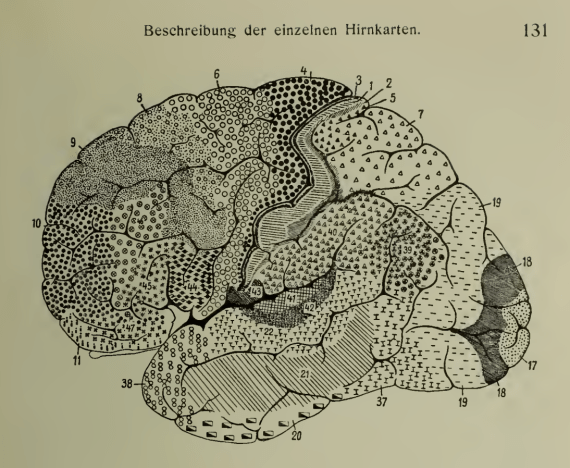
Part of the difficulty with assessing even weak modularity hypotheses, however, is that neuroanatomical research continues to revise the “parcellation” of the brain. The first such attempt was by Korbinian Brodmann, published in German in 1909  as “Comparative Localization Studies in the Brain Cortex, its Fundamentals Represented on the Basis of its Cellular Architecture.” He divided the cerebral cortex (the outermost “layer” of the brain) into 52 regions based on the structure of cells (cytoarchitecture) sampled from different sections of brains taken from 64 different mammalian species, including humans (see Figure 1). Although Brodmann’s studies were purely anatomical, he wrote: “my ultimate goal was the advancement of a theory of function and its pathological deviations.” Nevertheless, he rejected what he saw as naive attempts at functional localization:

[Dressing] up the individual layers with terms borrowed from physiology or psychology…and all similar expressions that one encounters repeatedly today, especially in the psychiatric and neurological literature, are utterly devoid of any factual basis; they are purely arbitrary fictions and only destined to cause confusion in uncertain minds.

20180522-Selection_003
Figure 1. Brodmann’s handdrawn parcellation of the human brain.

Over a century later, many researchers continue to refer to “Brodmann’s area” numbers as general orientation markers. More recently (see Figure 2), using data from the Human Connectome Project and supervised machine learning techniques, a team of researchers characterized 180 areas in each hemisphere — 97 new areas and 83 areas identified in previous work (Glasser et al. 2016). This study used a “multi-modal” technique which included cytoarchitecture, like Brodmann, but also connectivity, topography and function. For the latter, the study used data from “task functional MRI (tfMRI) contrasts,” wherein resting state measures are compared with measures taken during seven different tasks.

glasser-map

One of these tasks was language processing using a procedure developed by Binder et al. (2011) wherein participants read a short fable and then are asked a forced-choice question. Glasser et al. found reasonable evidence associating this language task with previously identified components of the “language network” (for recent overviews of the quest to localize the language network, see Frederici 2017 and Fitch 2018, both largely within the generative tradition).  Specifically, these are Broca’s area (roughly 44) and Wernicke’s area (roughly PSL), and also identified an additional area, which they call 55b). Their findings also agreed with previous work going back to Broca on the “left-lateralization” of the language network—which means not that language is only in the left hemisphere (as some folk theories purport), but simply the left areas show more activity in response to the language task than in homologous areas in the right hemisphere (an early finding which inspired Jaynes’ Bicameral Mind hypothesis)

Does this mean we have discovered the “language module” theorized by Fodor, Chomsky, and others? Not quite, for three reasons. First, Glasser et al. found if they removed the functional task data, their classifier was nearly as accurate at identifying parcels. Second, the parcels were averaged over a couple hundred brains, and yet the classifier was still able to identify parcels in atypical brains (whether this translated into changes in functionality was outside the scope of the study).

Third, and most important for our purposes, this work does not—and the researchers do not attempt to—determine whether parcels are uniquely specialized (or encapsulated in Fodor’s terms). That is, while we can roughly identify a language network implicating relatively consistent areas across different brains, this does not demonstrate that such structures are necessary and sufficient for human language, and solely used for this purpose. Indeed, language may be a “repurposing” brain parcels used for (evolutionarily or developmentally older) processes. This is precisely the thesis of neural “exaption.”

What is Exaption?

In the last few decades several new frameworks—under labels like neural reuse, neuronal recycling, neural exploitation, or massive redeployment—attempt to offer a bridge between the modularity assumptions which undergird most neuroanatomical research, on one hand, and the connectionist assumptions which spurred advancements in artificial intelligence research and anthropology on the other. Such frameworks also attempt to account for the fact there is some consistency in activation across individuals, which does look a little bit like modularity.

The basic idea is exaption (also called exaptation): some biological tendencies or anatomical constraints may predispose certain areas of the brain to be implicated in certain cognitive functions, but these same areas may be recycled, repurposed, or reused for other functions. Exemplars of this approach are Stanislas Dehaene’s Reading in the Brain and Michael Anderson’s After Phrenology.

Perhaps the easiest way to give a sense of what this entails is to consider cases of neurodiversity, specifically the anthropologist Greg Downey’s essay on the use of echolocation by the visually impaired. While folk understandings may suggest that hearing becomes “better” in those with limited sight, this is not quite the case. Rather, one study finds, when listening to “ a recording [which] had echoes, parts of the brain associated with visual perception in sighted individuals became extremely active.” In other words, the brain repurposed the visual cortex as a result of the individual’s practices. While most humans have limited echolocation abilities and the potential to develop this skill, only some will put in the requisite practice.

Another strand of research supporting neural exaption falls under the heading of “conceptual metaphor theory” (itself a subfield of cognitive linguistics). The basic argument from this literature is that people tend to reason about (target) domains they have had little direct experience with by analogy to (source) domains with which they have had much direct experience (e.g. the nation is a family). As argued in Lakoff and Johnson’s famous Metaphors We Live By, this metaphorical mapping is not just figurative or linguistic, but rather a pre-linguistic conceptual mappings, and an—if not the—essential part of all cognition (Hofstadter and Sander 2013). Therefore, thinking or talking about even very abstract concepts re-activates a coalition of neural associations, many of which are fundamentally adapted to the mundane sensorimotor task of navigating our bodies through space. As we discuss in our forthcoming paper, “Schemas and Frames” (Wood et al. 2018), because talking and thinking recruit areas of our neural system often deployed in other activities—and at time-scales faster than conscious awareness can adequately attend—our biography of embodiment channels our reasoning in ways that seem intuitive and yet are constrained by the pragmatic patterns of those source domains. This is fully compatible with the dispositional theory of the mental Omar discusses.

What does this mean for sociology? I think there are numerous implications and we are just beginning to see how generative these insights are for our field. Here, I will limit myself to discussing just two, specifically related to how we tend to think about the role of language in our work. First, for an actor, knowing what text or talk means involves an actual embodied simulation of the practices it implies, very often (but not necessarily) in service of those practices in the moment (Binder and Desai 2011). Therefore, language should not be understood as an autonomous realm wherein meanings are produced by the internal interplay of contrastive differences within an always deferred linguistic system. Rather, following the later Wittgenstein in the Philosophical Investigations, “in most cases, the meaning of a word is its use.” Furthermore, as our embodiment is largely (but certainly not completely) shared across very different peoples (for example, most of us experience gravity all the time), there is a significant amount of shared semantics across diverse peoples (Wierzbicka 1996)—indeed without this, translation would likely be impossible.

Second, the repurposing of vocabulary commonly used in one context into a new context will often involve the analogical transfer of traces of the old context. This is because invoking such language activates a simulation of practices from the old context while one is in the new context. (Although this is dependent upon the accrued biographies of the individuals involved). This suggests that our language can be constraining in predictable ways, but not because the language itself has a structure or code rendering certain possibilities unthinkable. Rather, it is that language is the manifestation of a habit inextricably involved in a cascade of other habits, making it easier to execute  (and therefore more probable for) some actions or thoughts over others. For example, as Barry Schwartz argued in his (criminally under-appreciated) Vertical Classification, it is nearly universal that UP is associated with power and also the morally good as a result of (near-universal) practices we encounter as babies and children. This helps explain the persistence of the “height premium” in the labor market (e.g., Lundborg, Nystedt, and Rooth 2014).


References

Binder, Jeffrey R. et al. 2011. “Mapping Anterior Temporal Lobe Language Areas with fMRI: A Multicenter Normative Study.” NeuroImage 54(2):1465–75.

Binder, Jeffrey R. and Rutvik H. Desai. 2011. “The Neurobiology of Semantic Memory.” Trends in Cognitive Sciences 15(11):527–36.

Dronkers, N. F. 2000. “The Pursuit of Brain–language Relationships.” Brain and Language. Retrieved (http://www.ebire.org/aphasia/dronkers/the_pursuit.pdf).

Fitch, W. Tecumseh. 2018. “The Biology and Evolution of Speech: A Comparative Analysis.” Annual Review of Linguistics 4(1):255–79.

Friederici, Angela D. 2017. Language in Our Brain: The Origins of a Uniquely Human Capacity. MIT Press.

Glasser, Matthew F. et al. 2016. “A Multi-Modal Parcellation of Human Cerebral Cortex.” Nature 536(7615):171–78.

Grodzinsky, Yosef and Katrin Amunts. 2006. Broca’s Region. Oxford University Press, USA.

Hofstadter, Douglas and Emmanuel Sander. 2013. Surfaces and Essences: Analogy as the Fuel and Fire of Thinking. Basic Books.

Lindenberg, Robert, Heiner Fangerau, and Rüdiger J. Seitz. 2007. “‘Broca’s Area’ as a Collective Term?” Brain and Language 102(1):22–29.

Lundborg, Petter, Paul Nystedt, and Dan-Olof Rooth. 2014. “Height and Earnings: The Role of Cognitive and Noncognitive Skills.” The Journal of Human Resources 49(1):141–66.

Viola, Marco and Elia Zanin. 2017. “The Standard Ontological Framework of Cognitive Neuroscience: Some Lessons from Broca’s Area.” Philosophical Psychology 30(7):945–69.

Wierzbicka, Anna. 1996. Semantics: Primes and Universals. Oxford University Press, UK.

Wood, Michael Lee, Dustin S. Stoltz, Justin Van Ness, and Marshall A. Taylor. 2018. “Schemas and Frames.” Retrieved (https://osf.io/preprints/socarxiv/b3u48/).


Connectionism: Alternatives to the Modular Brain, Part I

In my previous post, I introduced the task of cognitive neuroscience, which is (largely) to locate processes we associate with the mind in the structures of the brain and nervous system (Tressoldi et al. 2012). I also discussed the classical and commonsensical approach which conceptualizes the brain and mind relationship by analogy to computer hardware and software: distinct physical modules in the brain run operations on a limited set of innate codes (not unlike binary code) to produce outputs. One problem with this I discussed is theoretical: the grounding problem.

Another objection is empirical. If one proposes a strict relationship between functional modularity and structural modularity, using brain imaging technology, researchers should be able to identify these modules in neural architecture with some consistency across persons. However, researchers do not find such obvious evidence (Genon et al. 2018). For example, some of the researchers who pioneered brain imaging techniques, specifically positron emission tomography (PET), attempted to find three components of the “reading system” (orthography, phonology, and semantics) (e.g., Peterson, Fox, Posner, & Mintun, 1989). A decade later, researchers continued to disagree as to where the “reading system” is located (Coltheart 2004).

Part of the problem may be methodological: the technology remains rudimentary and advances come with tradeoffs (Turner 2016; Ugurbil 2016). The fMRI is the most common technique used in research, and high-resolution machines can measure blood flow in voxels (3-dimensional pixels) that are about 1 cubic millimeter in size. With an average of 86 billion neurons in the human brain (Azevedo et al. 2009), there are an average of 100,000 neurons in one voxel (although neurons vary widely in size and structure—see NeuroMorpho.org for  a database of about 90,000 digitally reconstructed human and nonhuman neurons), and each neuron has between hundreds to thousands of synapses connecting it (with varying strengths) to neighboring neurons. To interpret fMRI data, neuronal activity within each voxel is averaged, using the kinds of statistical techniques familiar to many sociologists, and must extract signal from noise. Therefore, it is important to bear in mind, like all inferential analyses, findings are provisional.

Connectionism in Linguistics and Artificial Intelligence

Even if non-invasive imaging resolution were to be extended to the neuronal level in real-time, it may be that there are no special-purpose brain modules to be discovered. That is, it may be that cognitive functions are distributed across the brain and nervous system, in perhaps highly variable ways. Such an alternative relies on a network perspective and comes with many potential forebearers, such as Aristotle, Hume, Berkeley, Herbert Spencer, or William James (Medler 1998).

Take for example Paul Broca and Carl Wernicke’s work on aphasia in the late 19th century. Noting the varieties if aphasia, or the loss of the ability to produce and/or understand speech or writing, Lichtheim (1885) concludes, following the work of Wernicke and Broca: different aspects of language (i.e. speaking, hearing speech, understanding speech, reading, writing, interpreting visual language) are associated with different areas of the brain, but connected via a neural network. Interruption along any one of these pathways can account for observations of the many kinds of aphasia.  

20180419-Selection_001.png
Figure from Lichtheim (1885:436), demonstrates the pathways connecting concepts (B) to “auditory images” (A) and “motor images” (M), each of which might be disrupted causing a specific kind of aphasia.

If language were produced by a discrete module, one would predict global language impairment, not piecemeal. Thus, this work developed the notion that so-called psychological “faculties” like language were distributed across areas of the brain. Following the logic of such evidence, an alternative perspective later referred to as connectionism, argues that the brain has no discrete functional regions and does not operate on symbols in a sequential process as a computer, but rather is distributed neural network which operates in parallel.

The connectionist approach (also called parallel distributed processing or PDP) coalesced primarily around PDP Research Group,  lead by David Rumelhart and James McClelland at the Institute for Cognitive Science at UC-San Diego, as an alternative to the generative grammar approach to modeling brain activity. In particular, the publication of Parallel Distributed Processing in 1986 marked the beginning of the contemporary connectionist perspective.

A key difference with prior computational approaches is that connectionist theories dispense with the analogy of mind as software and brain as hardware. Mental processes are not encoded in some language of thought or translated into neural architecture, they are the neural networks. Furthermore, unlike Chomsky’s generative grammar, a connectionist approach to language can better account for geographical and/or sociological variation—dialects, accents, vocabulary, syntax—within what is commonly considered the “same” language. This is because learning (from a connectionist perspective) plays a key role in both language use and form, and thus is easily coupled with, for example, practice theoretic approaches which reconceptualize folk concepts, like beliefs, into a species of habit.

Take, for example, Basil Bernstein’s pioneering work on linguistic variation across class in England (1960). He demonstrated that, independent of non-verbal measures of intelligence, those in the middle class would use a broader range of vocabulary (and therefore would score higher on verbal measures of intelligence) because elaborating one’s thoughts (and talking about oneself) was an important practice (and therefore habit) for the middle class, but not for the working class. As Bernstein summarized, “The different vocabulary scores obtained by the two social groups may simply be one index, among many, which discriminates between two dominant modes of utilizing speech” (1960:276).

Connectionism and Cognitive Anthropology

Beginning in the 1960s, cognitive anthropology was beginning to see problems with modeling culture using techniques like componential analysis (a technique borrowed from linguistics, see Goodenough 1956), which followed a decision-tree, or “checklist” logic. It is here a small theory-group in cognitive anthropology—called the “cultural models” school surrounding Roy d’Andrade while at Stanford in the 1960s and then UC-San Diego in the 1970s—circulated informally a working paper written by the linguist Charles Fillmore (while at Stanford) in which he outlined “semantic frames” as an alternative to checklist approaches to word meanings. In another paper circulated informally, “Semantics, Schemata, and Kinship,” referred to colloquially as “the yellow paper” (Quinn 2011:36), the anthropologist Hugh Gladwin (while also at Stanford) made a similar argument. Rather than explain the meaning of familial words like “uncle” in minimalist terms, anthropologists should consider how children acquire a “gestalt-like household schema,” and uncle “fits” within this larger cognitive structure.

However, it wasn’t until these cognitive anthropologists paired this new concept of cultural schemas with the connectionism that, according to Roy d’Andrade (1995) and Naomi Quinn (2011), a paradigm shift occurred in cognitive anthropology in the 1980s and 1990s. Quinn recalls the second chapter of Rumelhart, et al’s 1986 book, “Schemata and Sequential Thought Processes in PDP Models” gave the schema a “new and more neurally convincing realization as a cluster of strong neural associations” (Quinn 2011:38).

Beyond d’Andrade and his students and collaborators like Quinn and Claudia Strauss at Stanford, Edwin Hutchins, who also worked closely with Rumelhart and McClelland’s PDP Research Group, was instrumental in extending connectionism from the individual brain to a social group with his concept of “distributed cognition.” Independently of this US West Coast cognitive revolution, the British anthropologist Maurice Bloch was one of the first to recognize the importance of connectionism for anthropology. Beginning with his essay “Language, Anthropology and Cognitive Science,” in which he criticized his discipline for relying on an overly linguistic conceptualization of culture (a criticism which applies with full force to contemporary cultural sociology). 

In a follow-up post, I will consider more recent advances in understanding the brain-mind relationship, specifically the concept of “neural reuse,” and assess the connectionist model in light of this work.

References

d’Andrade, Roy G. 1995. The Development of Cognitive Anthropology. Cambridge University Press.

Azevedo, Frederico A. C. et al. 2009. “Equal Numbers of Neuronal and Nonneuronal Cells Make the Human Brain an Isometrically Scaled-up Primate Brain.” The Journal of Comparative Neurology 513(5):532–41.

Bloch, Maurice. “Language, anthropology and cognitive science.” Man (1991): 183-198.

Bernstein, Basil. 1960. “Language and Social Class.” The British Journal of Sociology 11(3):271–76.

Coltheart, Max. 2004. “Brain Imaging, Connectionism, and Cognitive Neuropsychology.” Cognitive Neuropsychology 21(1):21–25.

Genon, Sarah, Andrew Reid, Robert Langner, Katrin Amunts, and Simon B. Eickhoff. 2018. “How to Characterize the Function of a Brain Region.” Trends in Cognitive Sciences.

Goodenough, Ward H. 1956. “Componential Analysis and the Study of Meaning.” Language 32(1):195–216.

Lichtheim, Ludwig. 1885. “On Aphasia.” Brain 7:433–84.

Medler, David A. 1998. “A Brief History of Connectionism.” Neural Computing Surveys 1:18–72.

Petersen, S.E., Fox, P.T., Posner, M.I., Mintun, M. and Raichle, M.E., 1989. “Positron emission tomographic studies of the processing of single words.” Journal of Cognitive Neuroscience, 1(2), pp.153-170.

Quinn, Naomi. 2011. “The History of the Cultural Models School Reconsidered: A Paradigm Shift in Cognitive Anthropology.” Pp. 30–46 in A Companion to Cognitive Anthropology.

Rumelhart, David E., James L. McClelland, and the PDP Research Group. 1986. Parallel Distributed Processing. Cambridge, MA: MIT Press.

Tressoldi, Patrizio E., Francesco Sella, Max Coltheart, and Carlo Umiltà. 2012. “Using Functional Neuroimaging to Test Theories of Cognition: A Selective Survey of Studies from 2007 to 2011 as a Contribution to the Decade of the Mind Initiative.” Cortext. 48(9):1247–50.

Turner, Robert. 2016. “Uses, Misuses, New Uses and Fundamental Limitations of Magnetic Resonance Imaging in Cognitive Science.” Philosophical Transactions of the Royal Society of London. 371(1705).

Ugurbil, Kamil. 2016. “What Is Feasible with Imaging Human Brain Function and Connectivity Using Functional Magnetic Resonance Imaging.” Philosophical Transactions of the Royal Society of London. 371(1705).